How Easy Payment Plans (EPP) Actually Work
By FairLoan Team · August 1, 2026
An Easy Payment Plan, usually shortened to EPP, lets you convert a single credit card purchase into a series of fixed monthly instalments instead of paying — or financing — it all at once. Used well, it's one of the most useful features a card offers. Used carelessly, the fine print can cost you more than you expected. Here's how it actually works.
The basic mechanic
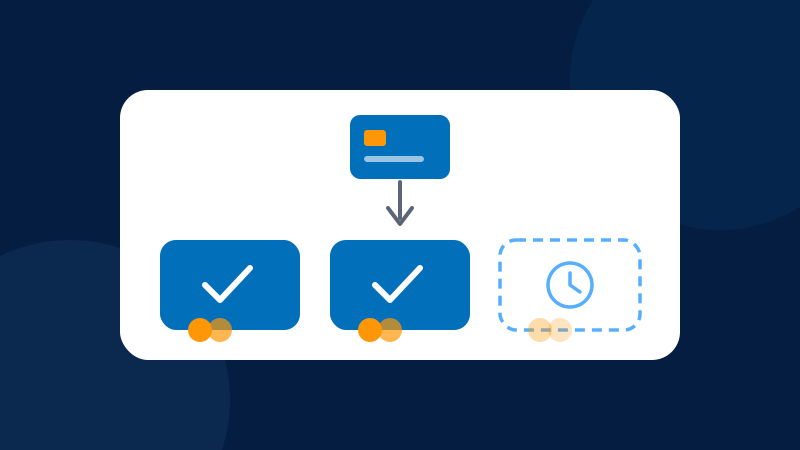
When you make an eligible purchase on your card — usually above a minimum transaction amount, commonly around LKR 5,000 — you (or the merchant, or your bank) can convert that single transaction into a fixed number of monthly instalments, typically 3, 6, 12, or sometimes up to 24 or 36 months depending on the card and the purchase category.
Once converted, that amount is removed from your regular revolving balance and tracked separately as an instalment plan. Each month, a fixed portion of it appears on your statement alongside whatever else you've spent on the card that month, until the plan is fully paid off.
0% vs interest-bearing EPP
There are two distinct types, and it matters which one you're actually getting:
- 0% (interest-free) EPP is usually a promotional arrangement, often sponsored by the merchant or the card network rather than the bank absorbing the cost outright. It's common at electronics retailers, furniture stores, and during retail campaign periods. You pay back exactly the purchase price, split evenly, with no interest.
- Interest-bearing EPP charges you reducing-balance interest across the tenor, similar in principle to a small personal loan. Banks may offer this when there's no merchant-funded 0% promotion available, or for cash-based EPP conversions of purchases you've already made.
The two can look identical on your statement at a glance — "12 equal instalments of X" — so it's worth confirming which type you're signing up for before you commit.
Bank-facilitated vs merchant-facilitated
EPP can be set up in two different ways:
- At the point of sale, arranged directly with the merchant — common for larger retail purchases, where the store's payment terminal offers to split the transaction into instalments as part of the checkout process, often tied to a specific promotional 0% campaign.
- After the purchase, by contacting your bank directly (by phone, app, or online banking) within a set window — usually a matter of days to a couple of weeks after the transaction date — to request conversion of an existing purchase into an instalment plan.
Not every purchase qualifies for after-the-fact conversion, and the interest rate offered this way is more likely to be the bank's standard EPP rate rather than a merchant-subsidized 0%.
The convenience fee — and why it's not the same as interest
Many EPP plans, including some advertised as "0% interest," still carry a convenience fee (sometimes called a processing fee) — a separate charge for the service of splitting the payment, distinct from interest on the outstanding balance. This fee might be charged upfront, added into the first instalment, or spread across the plan. A plan can genuinely be 0% interest and still not be free, once you account for this fee — so when comparing "0%" offers, check whether a convenience fee applies and how it's calculated before assuming the plan costs you nothing beyond the purchase price.
What happens to your available credit limit
Converting a purchase to EPP doesn't free up your credit limit the way paying off a balance normally would. The full outstanding value of the plan continues to be ring-fenced against your card's limit for the remainder of the tenor — so a large EPP commitment can meaningfully reduce how much "free" credit you have available on the same card for other spending until it's paid down.
The fine print worth checking before you say yes
- What happens if you miss an instalment. Most issuers will apply a late payment fee, and many will also reverse a promotional 0% rate — either on the remaining balance or retroactively on the whole plan — reverting to the card's standard interest rate. This is the single most expensive mistake to make with EPP.
- Early settlement terms. Some plans allow you to pay off the remaining balance early with no penalty; others charge an early settlement fee that can offset some of the benefit of paying it down faster.
- Whether it's genuinely 0%, or 0% interest plus a convenience fee that functions economically like a modest interest charge.
- The minimum transaction size and available tenors, which vary by bank and sometimes by merchant category — check these against your card's specific terms rather than assuming they match another card you've used before.
Using EPP well
- Only convert purchases you would have made anyway — EPP is a way to manage cash flow on a real expense, not a reason to spend more than planned.
- Avoid stacking too many active EPPs at once; each one quietly reduces your available credit limit until it's paid off.
- Set a reminder for each instalment's due date, separate from your regular statement due date if your bank tracks them differently.
- Read the merchant's or bank's specific terms at the point of signing up — "0%" offers vary enough between retailers and campaigns that it's worth the thirty seconds to confirm.
Used with a bit of care, EPP is genuinely one of the more useful features a Sri Lankan credit card offers — a way to access short-term, sometimes interest-free credit for a planned purchase without going through a separate loan application. The value depends entirely on reading the specific terms of the plan you're being offered, rather than assuming every EPP works the same way.